SEO is changing, but the foundations are still familiar.
Search engine optimisation has changed a lot over the years. Search engines are better at understanding what a page is about, people expect websites to load quickly, and more customers now discover businesses through AI-assisted search as well as a standard Google search.
That does not mean there is a secret new trick that makes a website rank. The useful fundamentals are still the same: answer real customer questions, make your services easy to understand, build trust, and give visitors a quick, comfortable experience on any device.
The technology behind a website can help with those things, but it cannot replace them. A beautiful, fast website still needs useful pages and a clear reason for someone to choose your business.
What a search-friendly website needs today.
Before comparing website platforms, it helps to know what they are all trying to achieve. A search-friendly site should be simple for both people and search engines to follow.
In practical terms, that usually means:
- A clear page for each important service, location or customer need.
- Helpful writing that answers the questions people actually ask before they enquire.
- Fast-loading pages that work well on a phone.
- Clear page titles, descriptions and headings that explain each page properly.
- Simple navigation and internal links so visitors can find their way around.
- Evidence that the business is real and trustworthy, such as reviews, project photos and useful contact details.
- Structured information behind the scenes so search engines can understand important details about the business and the article.
The important technology idea: give search engines a page they can read.
Some websites send a mostly empty shell to the browser and then build the page after a lot of code has loaded. This can look fine to a visitor eventually, but it can make the page slower and harder for search engines to process consistently.
A modern, well-built website can prepare the main page content before it reaches the visitor. In plain English, the text, headings and important links arrive ready to read. This is helpful for speed, accessibility and search visibility.
You do not need to memorise the technical names for this. What matters is asking your website team whether your key service and blog pages are delivered as complete, readable pages rather than relying on a large amount of browser-side code.
Next.js and TypeScript: a modern, flexible option.
Next.js is a modern way to build websites and web applications. TypeScript is an extra layer that helps developers catch mistakes while they are building. Together, they are often a strong choice for a custom website that needs to be fast, flexible and carefully maintained.
For SEO, a well-built Next.js site can prepare pages for search engines, create consistent page titles and social-sharing images, optimise images and keep the site quick as it grows. It is especially useful when a business needs a custom design, distinctive landing pages or features that do not fit neatly into an off-the-shelf template.
The main advantages are:
- Strong control over performance and the visitor experience.
- Pages can be prepared in a search-friendly format before they are viewed.
- A custom structure that can grow without being held back by a theme.
- Fewer unnecessary add-ons when the site is built thoughtfully.
- A safer, more predictable editing process for developers because TypeScript helps spot common mistakes early.
The trade-off is that it needs a developer or a capable website partner to make changes properly. It is not usually as simple as logging in and installing a plugin. For a business that wants a considered, long-term website, that extra care can be worthwhile.
Traditional HTML: simple, lightweight and dependable.
Traditional HTML is the original building block of the web. A simple HTML website can be extremely fast, easy for search engines to read and very dependable because there is less happening behind the scenes.
For a small business site with only a few pages that rarely change, this simplicity can be a real advantage. There are fewer moving parts and fewer things to maintain.
Its strengths include:
- Very light pages that can load quickly.
- Clear, readable page content for search engines.
- No heavy plugin collection to manage.
- A good fit for a small, stable brochure-style website.
The downside is that updates can become manual. Adding new articles, changing layouts or creating many location and service pages may take more time. Traditional HTML is not bad for SEO at all; it is simply less convenient when a website needs frequent content updates or more advanced features.
WordPress: practical, but the result depends on how it is built.
WordPress is one of the most widely used website platforms, and it can be very good for SEO. It gives business owners and marketing teams an easy way to add articles, update pages and manage content without editing code directly.
It also has a large ecosystem of themes and SEO tools. That can be useful, particularly for a business that publishes regularly and has someone internally who wants to manage the blog.
The advantages are:
- Straightforward content editing for non-technical users.
- A familiar blogging and publishing workflow.
- Many established themes, integrations and SEO tools.
- A practical option for businesses that need to publish often.
The risk is not WordPress itself. The risk is an overloaded site with a heavy theme, too many plugins or updates that are not looked after. That can affect speed, create compatibility issues and make the site harder to maintain. A carefully built, regularly updated WordPress site can perform very well; a neglected one can become slow and fragile.
So which option is best for SEO?
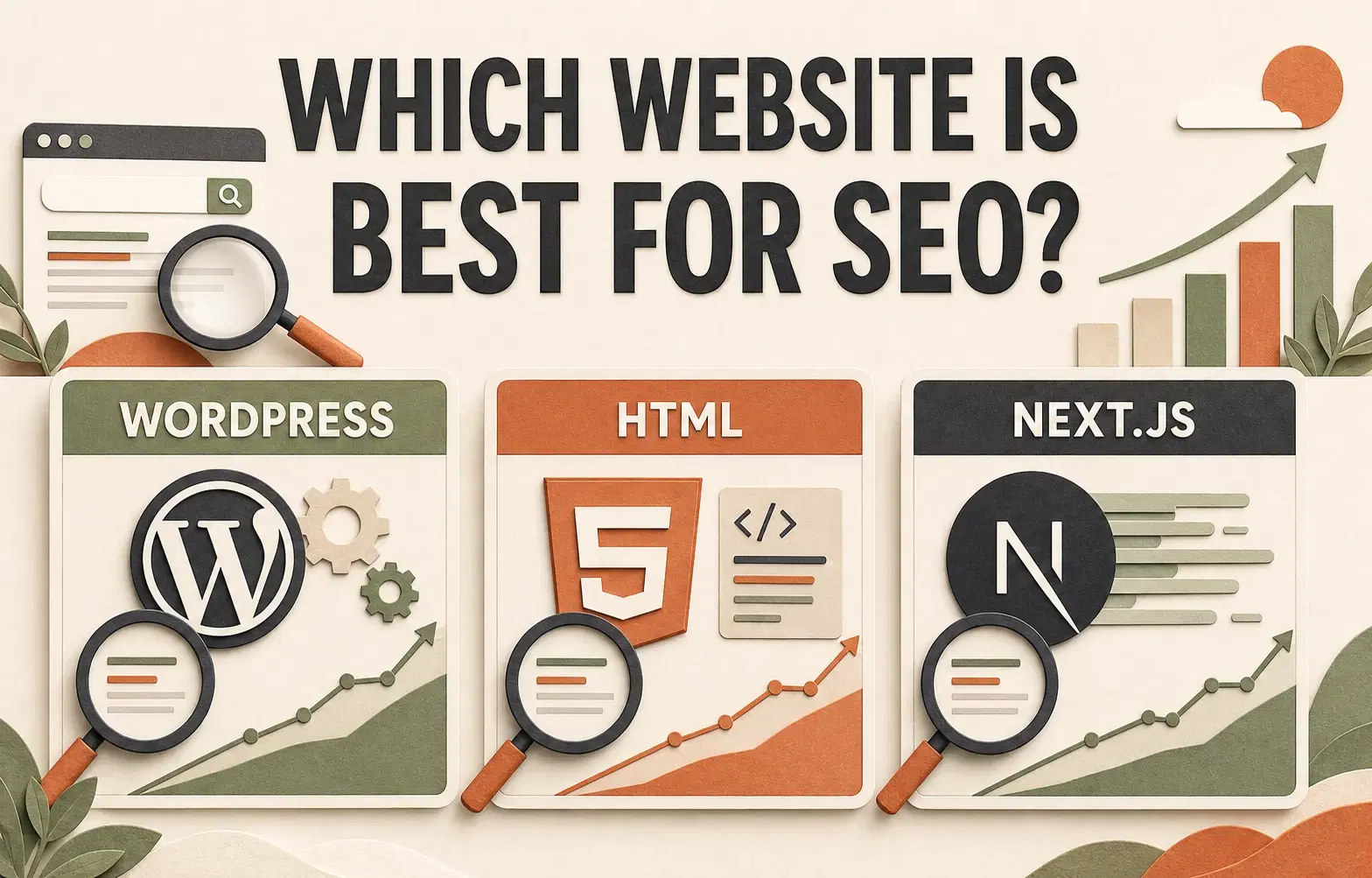
There is no single winner for every business. Search engines do not reward a website simply because it uses Next.js, HTML or WordPress. They reward pages that are useful, accessible, trustworthy and technically easy to understand.
The best choice comes down to how you need to run the website after it is launched.
As a simple guide:
- Choose a custom Next.js and TypeScript build when performance, flexibility and a tailored visitor journey are important.
- Choose WordPress when frequent, independent content publishing is the priority and the site will be actively maintained.
- Choose a traditional HTML site when the website is small, stable and does not need regular feature or content changes.
In all three cases, the quality of the build and the quality of the content matter more than the platform name.
Search trends worth planning for now.
The most useful SEO trend is a move away from thin pages written only to repeat a keyword. People want direct, trustworthy answers, and search systems are getting better at recognising whether a page genuinely helps.
This is also why businesses should make it easy to verify who they are. Clear contact details, service areas, author or team information, customer reviews and real project examples all help a visitor feel confident. They also make the website more useful when it is surfaced in newer AI-assisted search experiences.
Structured data is another helpful tool. It is a small amount of organised information behind the scenes that can help search engines understand that a page is an article, a business, a service or a review. It does not guarantee a higher ranking, but it reduces ambiguity and helps your website communicate clearly.
A practical checklist before building or rebuilding your website.
A new website should be treated as a long-term sales and marketing asset, not just a visual refresh. Ask these questions before choosing a platform or development team.
- Will each important service have its own useful, indexable page?
- Will the website be fast and easy to use on a mobile phone?
- Can the team add articles and update service information without damaging the layout?
- Are page titles, descriptions, image descriptions and social-sharing previews included?
- Will the site include article and business structured data where appropriate?
- Who will keep software, plugins and security updates current?
- How will old website links be redirected if the site is being replaced?
- Will you have access to performance and search reporting after launch?
The goal is not to chase a platform.
The best SEO website is one that is easy for your customers to use and easy for your business to keep useful. Modern technology can make a site faster, more flexible and easier to maintain, but it should support a clear business message rather than distract from it.
Whether you choose Next.js, WordPress or a simpler HTML website, focus on useful service pages, clear information, genuine proof and a smooth experience on mobile. Those are the foundations that continue to make a website discoverable and worth visiting.