Customers are starting to ask AI the questions they once typed into Google.
A customer might still type “bathroom renovator near me” into Google. But they may now ask an AI tool a longer question, such as “Which bathroom renovators should I talk to in Brisbane, and what should I ask before getting a quote?”
That change can feel confusing for a business owner. The good news is that you do not need a separate mystery strategy for every new AI tool. The strongest foundation is still a useful, well-built website that makes it clear who you help, where you work and why people can trust you.
This article explains the difference between a traditional search result and an AI answer, and what a service business can do to give itself the best chance of being found in both.
How Google Search works in simple terms.
Google regularly discovers pages across the web, reads what is on them and keeps information about suitable pages in a large search index. When someone searches, Google looks through that index and presents results it believes are the most useful and relevant for that particular query.
For a local service business, those results can include normal website listings, a map, Google Business Profile information, reviews, images and other search features. The exact results can change depending on the person’s location, device and wording of the search.
In other words, Google usually helps the person choose where to click next. Your job is to make the right page easy to find, easy to understand and worth choosing.
How AI search and recommendations are different.
Tools such as ChatGPT and Claude are designed to respond in a conversational way. Instead of only showing a list of links, they can combine information into an answer, explain options and sometimes cite websites they used while searching the web.
An AI answer is not simply a second copy of Google. Depending on the tool and the question, it may use its learned knowledge, search the live web, retrieve pages from the web or combine more than one source. Some answers will include links and citations; others may not use live web results at all.
That means no business can guarantee that an AI assistant will recommend or cite it. The sensible aim is to publish clear, accurate information that can be discovered, understood and trusted whenever an AI tool does look for current web sources.
Google Search and AI answers: the practical difference.
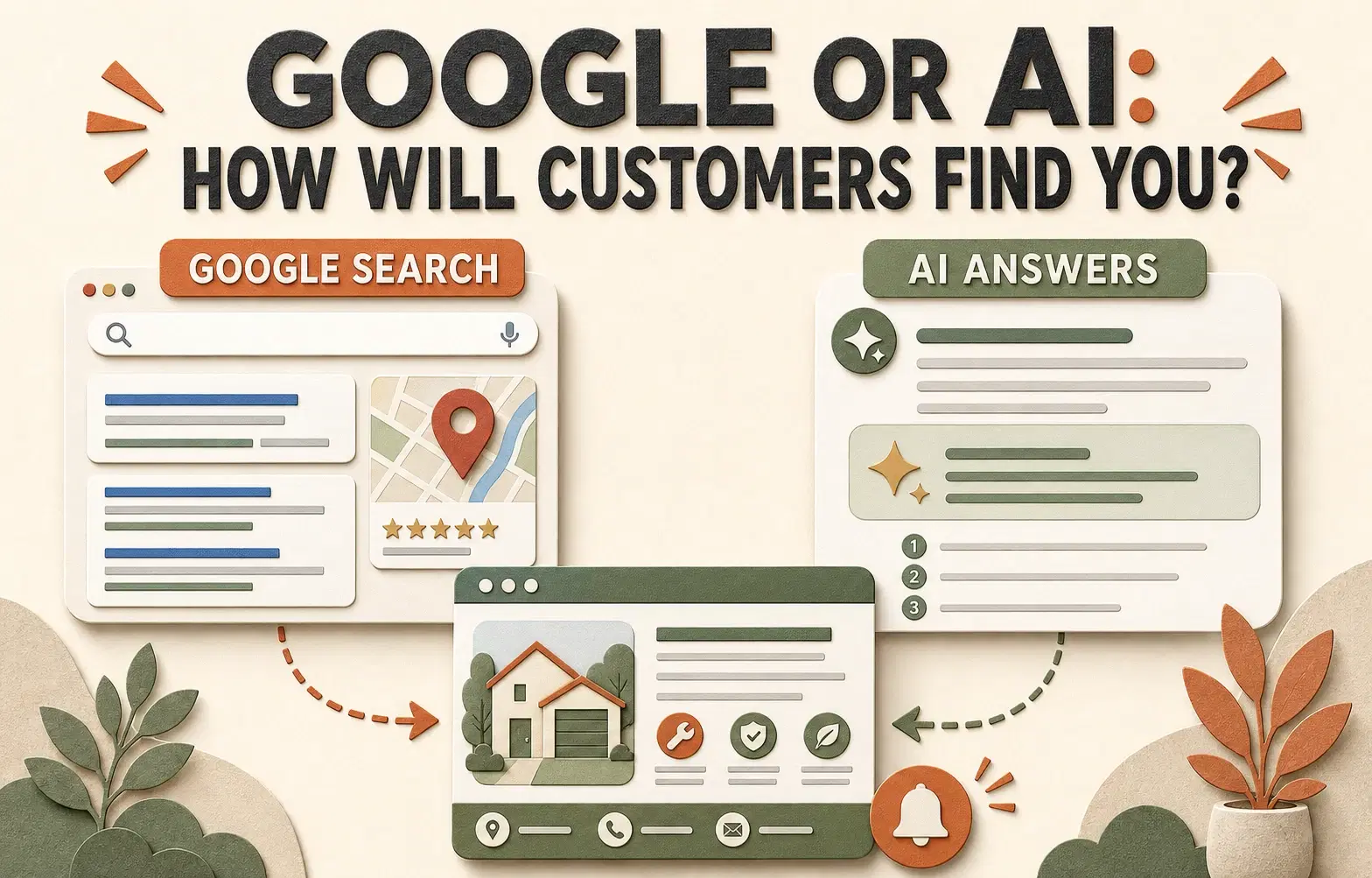
Both systems need reliable information, but they present it differently. Google tends to show choices for the customer to explore. AI tends to summarise, compare and guide the customer through a question.
For example, a Google search for “concreter in Toowoomba” may show a map and a group of local results. An AI question may be “What should I look for in a concreter for an exposed aggregate driveway in Toowoomba?” That answer needs specific, useful information it can explain and, where available, support with sources.
A helpful way to think about it is:
- Google Search helps people discover relevant pages and businesses.
- AI answers help people make sense of a question, often using information from several sources.
- Google is very focused on the search results page; AI can appear inside a longer conversation and follow-up questions.
- Both benefit when your website has clear, current content and a genuine reason to trust it.
Do not try to write for robots or AI tools.
The wrong approach is to fill a page with repeated phrases such as “best plumber” or “recommended builder” in the hope that an AI assistant notices. That does not build trust with a real customer, and it is not a sustainable SEO strategy.
Instead, write for the person who is deciding whether to contact you. Explain the service in plain language. Show examples of your work. Answer common questions honestly. Be clear about location, process, timing and the sort of jobs you are best suited to.
This is useful for traditional SEO and for AI-assisted discovery because it gives any system a clearer, more reliable picture of your business.
What service businesses should do now.
You do not need to rebuild your marketing overnight. Start by making sure the important information exists on your own website, rather than only on social media or in a short Google Business Profile description.
The most valuable priorities are:
- Create a useful page for each core service, not one vague page that tries to cover everything.
- State the suburbs, cities or regions you genuinely serve.
- Add real project examples, before-and-after images and customer reviews where appropriate.
- Answer the practical questions customers ask before they request a quote.
- Keep your contact details, service information and business hours accurate across your website and Google Business Profile.
- Make the site fast, mobile-friendly and easy for search crawlers to access.
- Use descriptive page titles, headings, image descriptions and internal links.
- Add structured business and article information behind the scenes so search systems can understand key details without guessing.
Build proof, not just pages.
A generic service page is easy to write and easy to ignore. A page that includes real work, practical explanations and evidence of experience is much more useful to a customer deciding who to contact.
For example, a landscaping business could explain how it approaches drainage on sloping blocks, show a completed project and outline what happens at the first site visit. A customer may find that page through Google, or an AI tool may use it as part of a sourced answer to a related question.
This is why useful content is not just blogging for the sake of blogging. It is proof that your business understands the work and can help a customer make a decision.
Make it easy for search tools to access your website.
Good content is only helpful if it can be found. Important pages should not be hidden behind a login, blocked from search engines or accidentally marked as noindex. They should have normal links from relevant pages and be included in the website sitemap.
For ChatGPT Search specifically, the website needs to allow its search crawler to access the site. A web host, security tool or content delivery network can sometimes block legitimate crawlers by mistake, so this is worth checking with your website team.
This is a technical detail, but it is a simple one: if you want to be eligible to appear in a search-based answer, do not prevent the relevant search crawler from reading your public pages.
What about ChatGPT, Claude and other AI tools?
Different AI products have different settings, sources and ways of showing references. ChatGPT can search the web and present cited sources when a question benefits from current information. Claude also offers web search with citations in supported settings. Other tools may work differently again, and those details will continue to change.
Rather than chasing every platform separately, keep your website as the reliable source of truth. Publish the information you want customers to understand, make it accessible to crawlers where you are comfortable doing so, and keep it current.
Never rely on an AI summary alone for important business information. Keep your own pages, Google Business Profile and customer communications accurate, because those are the places you control.
A simple organic visibility plan.
Organic visibility means being discovered without paying for each click. It takes time, but it builds an asset that can support referrals, Google searches and AI-assisted recommendations at the same time.
A practical monthly plan could be:
- Check that your key service and location pages are current and clear.
- Publish one genuinely useful article, project story or customer question-and-answer page.
- Add fresh photos, reviews or examples that show the quality of your work.
- Review Google Search Console for indexing problems and pages people are finding.
- Check that your Google Business Profile information matches your website.
- Look for gaps: what would a customer need to know before they feel ready to contact you?
The same good website helps in both places.
SEO is not being replaced; it is becoming part of a broader way people discover information. A strong website still needs to rank or be eligible to appear in traditional search results. The same clarity, proof and technical care also make it more useful when AI tools look for sources to support an answer.
Focus on being the clearest, most useful and most trustworthy answer for your customers. That is a better long-term strategy than trying to outsmart either Google or AI.