
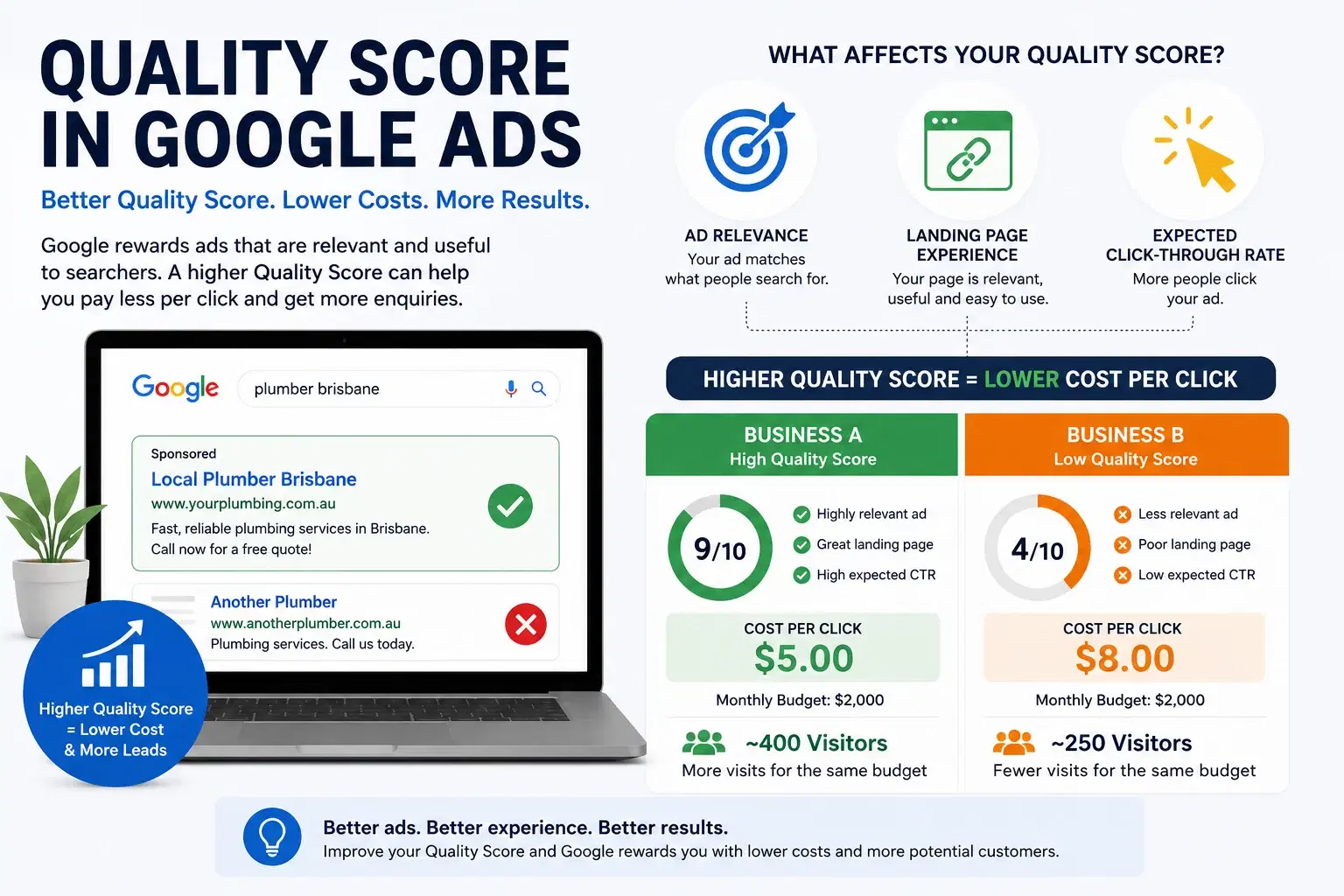
Quality Score can affect how much you pay.
If you are running Google Ads, you have probably heard the term Quality Score.
It might sound like something only marketing experts need to worry about, but it is actually one of the most important factors that can affect how much you pay for advertising.
The good news is that a higher Quality Score can often help you get more enquiries while spending less money.
Let us look at what it means in simple terms.
What is Quality Score?
Think of Quality Score as Google's rating of your advertisement.
Google gives each keyword a score from 1 to 10.
The higher your score, the more Google believes your advertisement is useful and relevant to the person searching.
For example:
- 8-10: Excellent.
- 5-7: Average.
- 1-4: Needs improvement.
Google wants people using its search engine to find helpful businesses. If your advertisement provides a good experience, Google is more likely to reward you with a higher Quality Score.
Why does Quality Score matter?
A higher Quality Score can reduce the amount you pay for each click.
Imagine there are two plumbers advertising in Brisbane. Both are willing to pay up to $15 per click.
Plumber A has a Quality Score of 9/10. Plumber B has a Quality Score of 4/10.
Even though both businesses are prepared to pay the same amount, Google may show Plumber A more often because Google believes their advertisement is more useful for the customer.
In many cases, Plumber A will actually pay less for each click than Plumber B.
That means they can receive more website visitors and more enquiries for the same advertising budget.
A simple real-life example.
Imagine two cafes sitting next to each other.
One has friendly staff, great coffee, clean tables and fast service.
The other has slow service, dirty tables and a confusing menu.
Even if both cafes spend the same amount on advertising, people are much more likely to return to the first cafe.
Google works in a very similar way. It wants to recommend businesses that provide a better experience for its users.
Quality Score is Google's way of measuring that experience.
What affects your Quality Score?
Google mainly looks at three things when measuring Quality Score.
- Ad relevance: If someone searches for "bathroom renovations Brisbane", they expect to see an advertisement about bathroom renovations. The closer your advertisement matches the search, the better.
- Landing page experience: If your ad says "Free Bathroom Renovation Quotes", the visitor should land on a relevant bathroom renovation page, not a general home page.
- Expected click-through rate: Google watches how often people click your advertisement compared with others. If more people choose your ad, Google assumes it is useful.
The easier and more relevant the experience feels for customers, the better your Quality Score is likely to be.
How can a higher Quality Score save money?
Let us imagine you have a monthly Google Ads budget of $2,000.
Business A has an average cost per click of $8. They receive around 250 visitors.
Business B has a better Quality Score, and their average cost per click drops to $5. Now they receive around 400 visitors.
The budget has not changed.
The only difference is that Google rewards the better-performing advertisements.
That is why improving Quality Score can make such a big difference over time.
Can Quality Score improve?
Absolutely. Quality Score is not permanent.
It can improve as your Google Ads campaign becomes better.
Some of the ways to improve it include:
- Writing advertisements that closely match what people are searching for.
- Sending visitors to the most relevant page on your website.
- Making your website fast and easy to use.
- Creating helpful content that answers customers' questions.
- Continuously improving your Google Ads campaign based on performance.
Even small improvements can lower your advertising costs over time.
Should you focus only on Quality Score?
Not necessarily.
Quality Score is important, but it is only one part of a successful Google Ads campaign.
The real goal is not simply to achieve a score of 10 out of 10.
The goal is to generate quality enquiries and new customers at a profitable cost.
Sometimes a keyword with a lower Quality Score can still produce excellent leads.
That is why experienced Google Ads managers look at the overall performance of a campaign, not just one number.
Final thoughts.
A high Google Ads Quality Score can help your business appear more often in Google search results while reducing the amount you pay for each click.
Think of it as Google's way of rewarding businesses that provide a better experience for potential customers.
The better your advertisements, the better your website and the more relevant your content, the more likely Google is to reward your campaign with a higher Quality Score.
Over time, that can mean lower advertising costs, more website visitors and ultimately more enquiries for your business.