
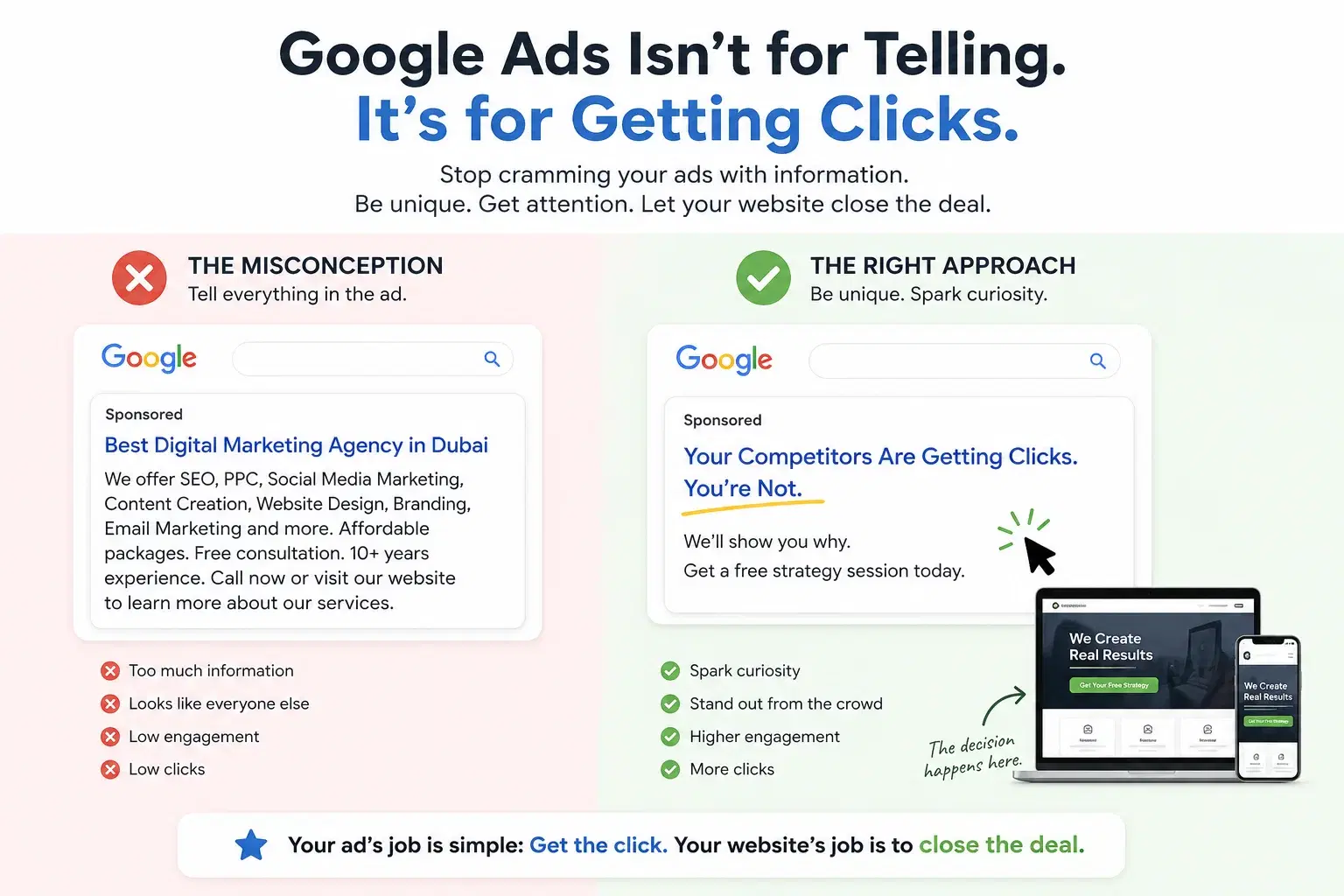
Your Google Ad has one main job.
Many businesses try to make a Google Ad explain everything: why they are experienced, family-owned, reliable, competitively priced and ready to provide a free quote.
Those things may all be true. But an ad is not the place where most people decide to choose your business.
Its first job is simpler: get the right person to notice your business and click through to your website.
The website is where they read the details, look at your work, build trust and decide whether to call or send an enquiry.
The ad earns the click. The website earns the enquiry.
Think of a Google search results page as a busy street. Several businesses may be offering similar services in the same area, using almost identical wording.
Your ad needs to give a searcher a reason to notice it before they scroll or click on someone else.
Once they land on your website, the role changes. That is where clear service information, testimonials, project photos, strong messaging and easy contact options help them feel confident enough to get in touch.
Trying to force every selling point into one small ad often makes it less effective at the one thing it needs to do first.
Why generic wording gets ignored.
Searchers see a lot of familiar phrases in Google Ads. When every ad uses the same claims, the wording stops standing out.
A phrase such as 'family business', 'free quote' or 'quality service' is not automatically a problem. The problem comes when it is the only thing the ad gives someone to notice.
If four competitors all say nearly the same thing, their ads blend into one another. A searcher has little reason to click one instead of another.
Common examples of wording that can become invisible when everyone uses it include:
- Family-owned business.
- Free quotes.
- Quality workmanship.
- Friendly and reliable service.
- Affordable prices.
- Call today.
These claims can still support an ad when they are relevant, but they should not be the whole strategy.
Give people a reason to pay attention.
Effective ad copy usually starts with the searcher's situation. It makes the service feel relevant, specific or timely enough that they want to find out more.
For a local service business, this could mean highlighting a particular service, an urgent problem you solve, a clear location focus or a useful difference in the way you work.
The goal is not to use exaggerated promises or clickbait. It is to be clearer and more interesting than the same recycled claims around you.
Depending on the service, an ad may earn more attention by focusing on:
- The exact problem the customer is trying to solve.
- A specialised service competitors have not mentioned.
- A clear local area or fast response when that matters.
- A practical outcome the customer wants.
- A strong reason to explore the website further.
A better click-through rate gives your campaign more opportunity.
When the right people notice and click your ad, you create more chances for your website to convert them into enquiries.
That does not mean chasing clicks from everyone. The message still needs to match the search and accurately lead into the page someone reaches after clicking.
The best ad and landing page combinations work together: the ad opens the door, then the website answers the questions that help a customer make a real decision.
Do not make the ad do the website's job.
Your Google Ad should be concise, relevant and interesting enough to earn attention. Your website should then make the case for choosing you.
That distinction changes how you write campaigns. Instead of squeezing every benefit into an ad, choose the strongest angle that will make the right customer want to learn more.
Then make sure the landing page follows through with the information, proof and contact options they need.
Great Google Ads are not simply a list of business claims. They are the first step in a journey designed to turn a search into an enquiry.